Product category
Product category
Degree of darkening
Degree of darkening
Colour
Colour
Room recommendation
Room recommendation
Curtain height
Curtain height
Material type
Material type
Sample
Sample

Product filter

Degree of darkening
Degree of darkening
Colour
Colour
Room recommendation
Room recommendation
Curtain height
Curtain height
Material type
Material type
Sample
Sample

Light-transmitting curtains

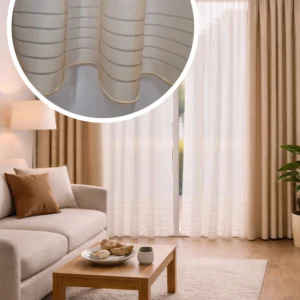
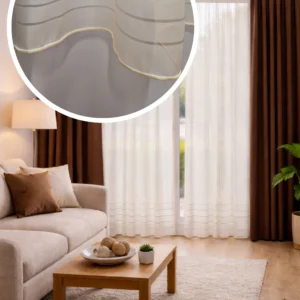
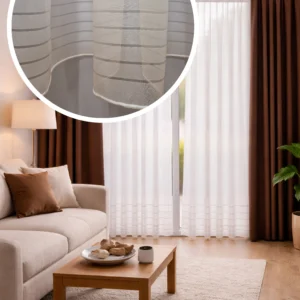
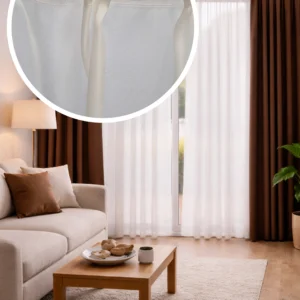
The translucent curtains softly filter out natural light, creating a bright, pleasant and cosy atmosphere in the room. Ideal for living rooms, kitchens or spaces where it is important to keep light in while maintaining intimacy. Its airy appearance makes it an elegant addition to any interior. Order your translucent curtains ready sewn or by the metre from us!

Why choose a translucent curtain?

Translucent curtains are the ideal choice if you want to create a bright yet cosy atmosphere. It softly filters incoming sunlight, keeping the room bright while providing the intimacy you need.

Its clean look makes it easy to fit into any interior, whether modern or classic. Different materials and textures allow you to choose the exact curtain that suits your home.

A well-chosen translucent curtain is not only a decorative element, but also a key element in the ambience of a space, providing both a practical and aesthetic solution.

Where is a translucent curtain recommended?

Translucent curtains are ideal for rooms where it is important to preserve natural light but also need a little intimacy. Most often chosen for living rooms, dining rooms and kitchens where you want to create a bright, open and welcoming atmosphere.

It can also be a good solution for bedrooms and children's rooms, especially when used in combination with blackout curtains. It provides a pleasant filtered light during the day and the blackout provides complete blackout at night.

It works well in both modern and classic interiors, as its light, airy appearance does not clutter the space but elegantly complements it.

Benefits of custom-made curtains

The biggest advantage of a custom-made curtain is that it fits perfectly to your window and the space. You don't have to compromise on size, drape or appearance, because every detail is made to your specifications.

A tailor-made curtain is aesthetically more pleasing than a finished product. With the right width and pleating, it gives a more elegant, tidy overall look, enhancing the appearance of the whole room.

It's also a better choice functionally: it covers exactly what you need and works the way you expect. If you are looking for a truly sophisticated and durable solution, a custom curtain is the best choice.

Scroll to Top

Folding guide

Choosing an abundance of curtains for the right fall and look is paramount.
 

Light-transmitting curtains we usually recommend 1.5x, 2x or even 2.5x depending on the density of the material, but 2x is the most common choice for a nice, full effect.
For blackout curtains depending on the thickness, 1.5x or 2x the thickness is recommended, where 1.5x is the most common solution.

For white curtains, you can choose either white or transparent pleats, but in many cases the transparent version is aesthetically preferable. When using rod curtains where the pleat remains visible, a transparent pleat is particularly recommended, with a wider pleat of about 5 cm, which gives a more elegant and cleaner overall effect. This guideline also applies to blackout curtains.

Curtain sizing guide

Curtain sizing guide

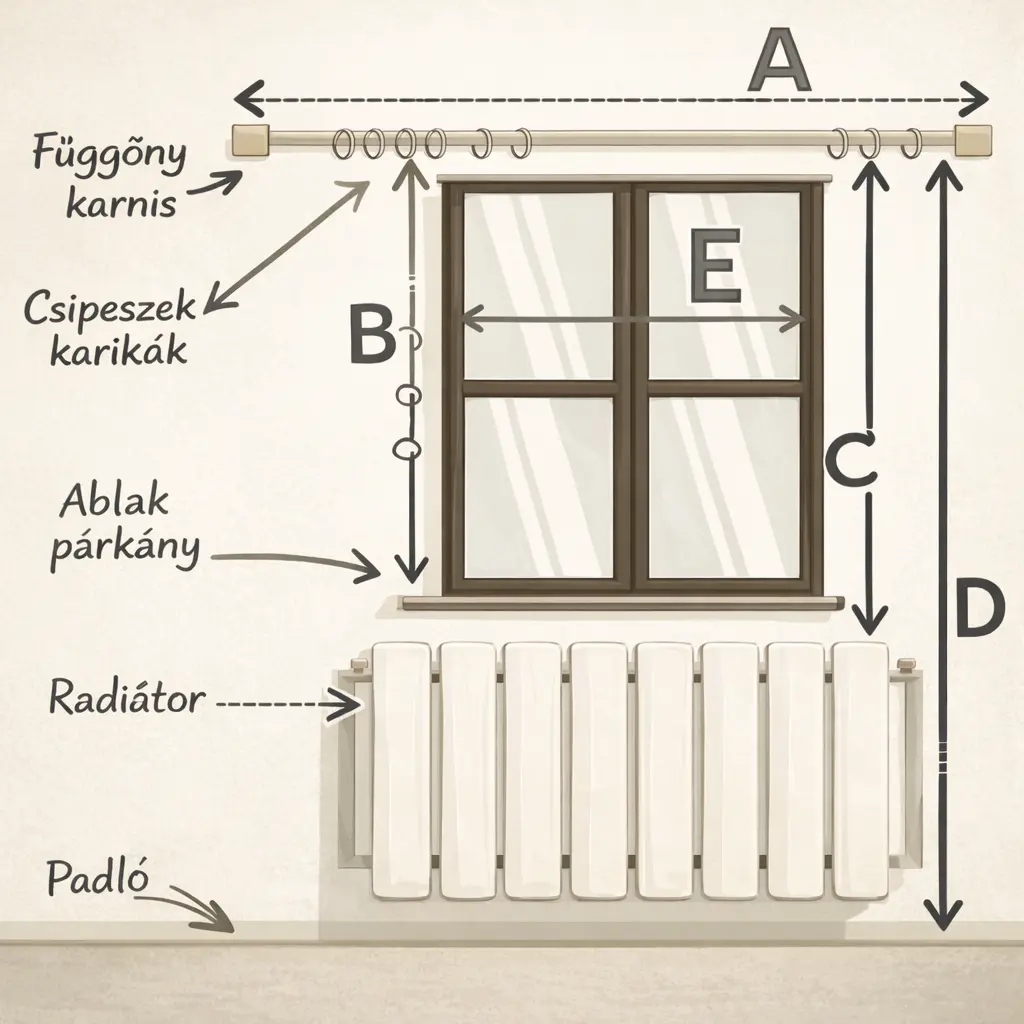
Determine the width of the curtain:
The required width is always determined by the size of the valance or curtain rail (A), not the width of the window.
If you are installing a new harness, it is advisable to make it about 10-20 cm longer on each side of the window. This way, when the curtain is pulled aside, it will not cover the glass surface. It is recommended to fix the curtain at least 15 cm above the top of the window.
When using rod curtains, the decorative elements at the end of the rod are not included in the width of the curtain.
In the case of curtains, the measurement is taken between the edges of the inner frame of the window, and a few centimetres are added to allow for the curtains to extend beyond the glass.(E)

Calculate the length (height) of the curtain:
The length of the curtain can be defined in several ways: it can reach the windowsill (B), hang slightly below (C) or even the floor (D).
To get an accurate result, measure the height at least at three points (left, middle and right), as the floor, ledge or cornice is not always perfectly straight. The lowest of the three measurements should be taken.
The starting point of the measurement should be the centre of the clips or curtain rings at the top.
If you want the curtain to reach the sill or the floor, subtract 2 cm from the resulting size to avoid the material touching the surface and getting dirty or friction.
If there is no sill or if the cornice is within the plane of the sill, measure the distance to the bottom edge of the window or sill and add about 15-20 cm.
If there is a radiator under the window, make sure that there is at least 2 cm between the curtain and the radiator to allow for proper airflow and safety.